

Key Takeaways
- Verify movers through FDACS registration on FloridaConsumerHelp.com or 1-800-HELP-FLA before hiring; licensed movers must carry insurance and renew annually, protecting you if items are damaged or lost.
- Request written estimates from at least three companies detailing legal business name, registration number, services, fees, and total cost; verbal quotes offer no protection and are easy to dispute later.
- Ask directly whether you're hiring a moving carrier or broker; carriers use their own crews and trucks with clear accountability, while brokers hire third parties, which can complicate responsibility if problems occur.
- Watch for red flags including large cash deposits without contracts, inability to provide registration numbers, verbal-only estimates, unmarked trucks, and unresolved damage complaints in online reviews.
- For interstate moves across state lines, movers need both state FDACS registration and a federal USDOT number; confirm both credentials if relocating outside Florida.
- If disputes arise, document everything with photos and written notes, contact the company first, then file complaints with FDACS (1-800-HELP-FLA) or Florida Attorney General; keep all contracts and receipts.
Moving is exciting, but let's be honest, it can also feel a little scary. You are trusting a stranger with your grandmother's china, your kid's crib, and everything else that makes your house a home. That is exactly why knowing how to find licensed movers Polk County Florida families trust matters so much. It is not just paperwork. It is peace of mind.
Here in Central Florida, from Lakeland to Winter Haven to Davenport, plenty of moving trucks roll through town every single day. But not every company behind those trucks is properly registered, insured, or ready to handle your belongings with care. This guide will walk you through exactly what "licensed" really means in Florida, how to check a mover's credentials, and what questions to ask before you sign anything. Grab a cup of coffee, and let's get you moving day ready.

Why Licensing Actually Matters for Your Move
Think of a moving license like a seatbelt. You hope you never need it, but you will be very glad it is there if something goes wrong. In Florida, household goods movers and moving brokers must register with the Florida Department of Agriculture and Consumer Services, known as FDACS, before they can legally operate under Chapter 507 of Florida law.
This rule applies to moves that both start and end in Florida, which covers most local moves across Polk County. Registration is not just a formality. It requires movers to carry proof of insurance and pay an annual fee, giving you a layer of protection if something breaks or goes missing.
- Registered movers must show proof of active insurance coverage
- FDACS keeps a public record you can search anytime
- Registration must be renewed, so status can change year to year
- Unregistered movers operating illegally have little accountability if things go wrong
According to a 2024 Florida Senate bill analysis, there were 1,348 registered movers and 39 registered moving brokers statewide as of December 2023. That is a lot of trucks on the road, and it makes checking credentials even more important before you hand over your belongings.
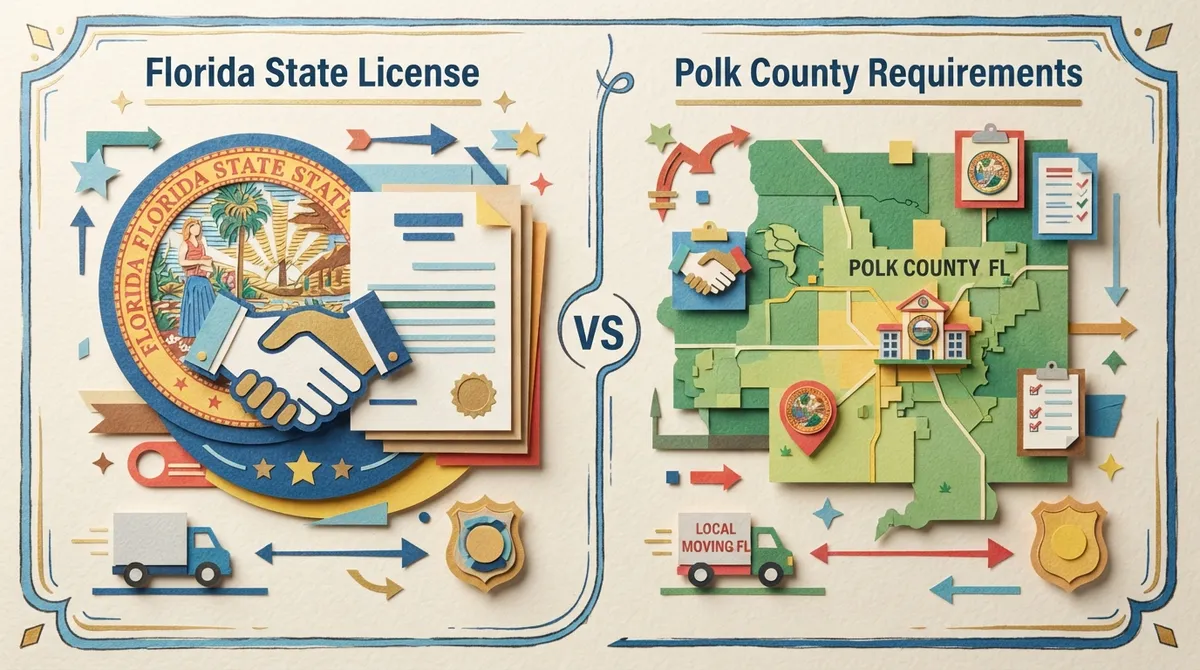
Florida State License vs. Polk County Requirements
Here is something that trips people up. There is no separate "Polk County moving license" that exists apart from the state system. Florida handles mover registration at the state level through FDACS, and that registration applies whether you are moving within Lakeland, Bartow, Auburndale, or anywhere else in the county.
That said, some cities may require a local business tax receipt, which is a bit different from a moving license. If you want extra peace of mind, it never hurts to ask a company directly about both their state registration and any local business requirements. A trustworthy mover will answer without hesitation.
If you are curious how licensing connects to overall trust and service quality, our article on 9 Ways To Spot Licensed And Insured Movers In Polk County breaks it down even further.
How to Verify a Mover's License Step by Step
Checking a company's credentials sounds intimidating, but it really is not. Here is a simple process you can follow before you ever hire anyone.
- Get the full legal business name. Ask the company for their exact registered name, not just a nickname or website title.
- Search FDACS records. Use FloridaConsumerHelp.com or call 1-800-HELP-FLA to confirm the company shows up as an active registrant.
- Confirm insurance coverage. Ask for proof of liability insurance and cargo coverage in writing.
- Ask if they are a carrier or a broker. Brokers arrange moves but may hire someone else to do the actual driving and lifting.
- Check for complaints. A quick search can reveal patterns of unhappy customers or unresolved disputes.
Do not just trust a website badge that says "licensed and insured." Anyone can put that text on a page. Verifying through official channels only takes a few minutes and can save you a massive headache later.
Mover vs. Broker: Know the Difference
This is one of the most misunderstood parts of hiring help for a move. A moving company physically loads, transports, and unloads your belongings. A moving broker, on the other hand, arranges the move but hands it off to a different carrier to actually do the work.
There is nothing automatically wrong with brokers, but you need to know who you are really hiring. If a problem happens on moving day, you want to know exactly who is responsible.
| Feature | Moving Company (Carrier) | Moving Broker |
|---|---|---|
| Who does the physical move | Their own crew and trucks | A third-party carrier they hire |
| Accountability | Direct and clear | Can be harder to track down |
| Pricing transparency | Usually more predictable | May change once carrier is assigned |
| Best for | Straightforward local or long-distance moves | Comparing multiple quotes quickly |
Whichever route you choose, always ask directly: "Are you the company doing my move, or are you hiring someone else?" A good company will tell you the truth without dancing around it.
What a Solid Written Estimate Should Include
Florida's consumer protection guidance strongly recommends getting a written estimate, not just a phone quote. A verbal number is easy to forget or dispute later. A written estimate protects both you and the mover.
Your estimate should clearly spell out the following:
- The mover's legal business name and registration number
- A detailed list of services included, such as packing, loading, and heavy lifting
- Any extra fees for stairs, long carries, or specialty items
- The total estimated cost and how final charges will be calculated
- Insurance and liability coverage details
Florida's guide to protecting yourself recommends getting at least three estimates before choosing a mover. This gives you a realistic sense of pricing and helps you spot any red flags, like a quote that seems too low to be true. For more on how pricing works in our area, check out What Should You Expect From A Free Moving Estimate.
Local Moves vs. Long-Distance Moves: Does Licensing Change?
Great question, and one we hear a lot from folks planning a move out of Central Florida. If your move starts and ends inside Florida, state FDACS registration is the main credential to check. But if you are moving across state lines, federal rules from the Federal Motor Carrier Safety Administration come into play as well.
This means interstate movers need a USDOT number in addition to any state-level registration. If you are planning a move from Lakeland to another state, it is smart to ask about both. Our guide on What Should You Know Before A Long Distance Move covers more of these details.
Special Considerations for Different Types of Movers
Not every move looks the same, and licensing checks matter a little differently depending on your situation.
Retirees Moving to a New Community
If you are downsizing into a retirement community, you want a crew that is patient, careful, and properly insured for heavy lifting. Verifying license status protects your furniture and your peace of mind during an already emotional transition. Our resource on 8 Senior Moving Services Polk County Fl That Help has more helpful tips.
Families With Large Homes or Estates
Bigger homes mean bigger furniture, and bigger furniture means more risk if something goes wrong. A licensed, insured team gives you a safety net if a specialty piece gets damaged during transport.
Luxury Apartment and High-Value Home Residents
When you are moving into an upscale space, property managers often require proof of insurance before movers can even use the elevator or loading dock. Licensed movers can provide that documentation quickly, keeping your move on schedule.
Red Flags That Signal an Unlicensed or Risky Mover
Trust your gut here. If something feels off, it probably is. Watch out for these warning signs:
- They ask for a large cash deposit upfront with no written contract
- They cannot provide a registration number when asked directly
- Their estimate is verbal only, with nothing in writing
- They show up in an unmarked truck with no company branding
- Online reviews mention damaged items with no resolution offered
If you spot even one of these red flags, it is worth pausing and looking elsewhere. A few extra minutes of research can save you thousands of dollars and a lot of frustration.
What to Do If Something Goes Wrong
Even with the best planning, sometimes things do not go as expected. If a mover damages your belongings or charges more than what was agreed upon in writing, you have options.
First, contact the company directly and document everything with photos and written notes. If that does not resolve things, you can file a complaint with FDACS through their consumer help line. The Florida Attorney General's office also accepts complaints and can be reached through their consumer protection resources, including guidance found on the Florida Attorney General's consumer guide to moving. You can also call 1-866-9-NO-SCAM to report suspected fraud.
Keeping copies of your estimate, contract, inventory list, and payment receipts makes any dispute much easier to resolve. For a full breakdown of how claims work, take a look at What Steps Get Your Moving Claim Paid Fast.
Why DynaMight Movers Takes Licensing Seriously
At DynaMight Movers, we know trust is earned, not assumed. We are proud to be a licensed and insured moving company serving Lakeland, Winter Haven, Davenport, Dover, and the greater Polk County area. That means transparent pricing, real accountability, and a team that shows up ready to protect what matters most to you.
Whether you are handling a simple apartment move or coordinating a full estate relocation with specialty items like pianos or antiques, we bring the muscle and the professionalism to get it done right. You can also see what our neighbors are saying by checking out Visit us on Google — DynaMight Movers for real feedback from real customers across the county.
For more background on how our licensing and insurance protect you, take a look at 8 Signs Your Movers Are Licensed And Insured In 2026 and 5 Reasons Licensed Movers Are Worth It In 2026.
A Quick Checklist Before You Book Your Move
Before you sign any contract, run through this simple checklist. It only takes a few minutes but can save you a world of stress.
- Confirm the company's FDACS registration status
- Get at least three written estimates for comparison
- Clarify whether you are hiring a carrier or a broker
- Ask about insurance coverage for high-value or specialty items
- Read reviews and check for unresolved complaints
- Keep copies of every document related to your move
Following these steps puts you in control of your move instead of leaving things to chance. It also helps you walk into moving day feeling confident instead of anxious.
Ready to Move With Confidence?
Choosing licensed movers Polk County Florida residents can rely on does not have to be complicated. With a little research and the right questions, you can protect your belongings, your budget, and your sanity. DynaMight Movers is here to make that process even easier with straightforward pricing and a team that treats your home like it matters, because it does.
Ready to see the difference a licensed, insured, and genuinely caring moving team can make? Get a free estimate today, or if you would rather talk it through with a real person, call us at (866) 349-7719. We are ready when you are.
FAQs
Q: How do I verify that a moving company is registered in Polk County, Florida?
A: You can check any mover's status through FDACS's business search tool on FloridaConsumerHelp.com, or simply call 1-800-HELP-FLA. Always confirm the company's exact legal name before searching, since typos or nicknames can make it seem like a mover is not registered when they actually are.
Q: Do movers in Polk County need a Florida state license or a county license?
A: Movers in Polk County need to be registered with the state through FDACS under Chapter 507, since Florida does not issue a separate county-level moving license. Some cities may require a local business tax receipt too, so it never hurts to ask about both when you are comparing companies.
Q: What is the difference between a moving company and a moving broker?
A: A moving company actually performs the move with its own truck and crew, while a broker arranges the move and hires someone else to do the heavy lifting. Both can be legitimate, but you should always ask directly who will be showing up on moving day so there are no surprises.
Q: What should a written moving estimate in Florida include?
A: A solid written estimate should list the company's legal name and registration number, a breakdown of services, any potential extra fees, and total estimated cost. It is always smart to get this in writing rather than relying on a verbal quote over the phone.
Q: What should I do if a mover damages my belongings or overcharges me?
A: Start by documenting the damage with photos and reaching out to the company directly to resolve it. If that does not work, you can file a complaint with FDACS or the Florida Attorney General's office, and keeping your original contract and inventory list will make the process much smoother.